
Alison Hewett


Alison Hewett
'A proudly pragmatic voice looking to Restore Britain'


COST OF LIVING CRISIS What’s Really Going On — And What Needs to Change If you feel like your money doesn’t go as far as it used to, you’re not imagining it. Families across our communities are being squeezed from every direction — food, energy, fuel, housing. The basics of everyday life have become a constant worry. And yet, too often, the explanations we’re given are either too simplistic or just plain incomplete. Yes, global events have played a role. The war in Ukraine disrupted energy supplies. COVID lockdowns slowed production and strained supply chains. When economies restarted, prices surged. But that’s only part of the story. What we’ve also seen is poor decision-making closer to home. Overreliance on imports, a lack of long-term energy planning, and policies that don’t reflect the real lives of working people have all made things worse. Instead of resilience, we’ve ended up exposed. And when governments get stuck in one way of thinking — treating every problem like it has the same solution — ordinary people pay the price. Because this isn’t just about economics. It’s about real life. It’s about parents skipping meals so their kids can eat. It’s about pensioners worrying about heating their homes. It’s about small businesses trying to stay afloat while costs climb higher and higher. People don’t want slogans. They want honesty. They want practical solutions. That means: - A serious plan for energy security, using the resources we have - Policies that support working families, not just headlines - Investment in local economies so communities can stand on their own feet - And leadership that listens — not lectures We can’t control every global event. But we can control how prepared we are, and how we respond. Right now, too many people feel like they’re being talked at, not stood up for. That needs to change. Because this country works best when it works for everyone — not just those at the top, and not just those who shout the loudest. It’s time to bring back some common sense, some balance, and a bit of straight talking. That’s the kind of leadership I believe in.
IMMIGRATION & ASYLUM People ask me where I stand on immigration — so let me be clear. I’m not speaking from theory. I’m speaking from experience. I’ve been on the front line. I conducted official first interviews with illegal migrants arriving into Dover. We were told our role was to gather as much information as possible at that first point of contact, before human rights lawyers got to the port. So I’ve seen how this system works — up close. I saw how often cases at that early stage were unclear, vague and inconsistent, or lacked a convincing basis. That’s not about judging individuals — it’s about a system under real strain. And right now, that system isn’t working. When systems are purposefully overwhelmed, shortcuts have to happen — and that’s when trust is lost. If you can’t properly check, you can’t properly decide. It’s as simple as that. And let’s be honest about something else. If the system cannot properly assess claims in a timely and controlled way, then people should not simply be released into communities without clarity. If you can’t assess properly, you can’t release responsibly. Claimants should be accommodated in secure, humane facilities while their claims are properly assessed. That’s not about punishment — it’s about ensuring the system is fair, orderly, and trusted. Because without that, you lose confidence on all sides — from the public, and from those with genuine claims who deserve a proper decision. A system that works is one that is both humane and in control. Right now, we’re struggling to deliver either. I believe in fairness, control, and common sense. We’ve got communities under pressure — housing stretched, GP services overwhelmed, schools struggling to keep up. And people can see that pressure in everyday life — including in our NHS. That’s not good enough. We also have to remember the people already legally here — the families, the workers, the communities trying to get on with their lives. Because for too long, many people have felt they couldn’t even raise concerns about immigration without being dismissed, labelled, or ignored. For too long, people felt talked down to instead of listened to — and that’s where trust was lost and deep overwhelming resentment started. And in too many cases, those concerns have been borne out — whether that’s pressure on housing, strain on services, or communities feeling stretched. That’s not healthy in a democracy. We need a pause to immigration and breathing time to see what if any immigration we wish to allow. That means welcoming people who contribute, who have the skills we genuinely need, and who want to be part of this country. And it also means having the confidence to say no when it’s not sustainable. Or if we just do not want a certain group.= A country has the right to choose who it can support — that’s not extreme, that’s responsible. People say we need ever-increasing immigration just to survive. I don’t accept that. For most of our modern history, immigration was far lower than it is today — and this country still built its economy, its institutions, and its identity. Relying on constantly increasing immigration isn’t a long-term plan — it’s a failure to invest in our own workforce and productivity. And too often, what we’re seeing now is government reacting to the consequences of decisions made years ago — decisions that were never properly put to the public. That’s not how trust is built. And then you have policies like the SNP’s “sanctuary” approach. I understand the intention — people want to show compassion. But policy has to work in the real world, not just sound good. You cannot support communities while ignoring the pressure they’re already under. Because compassion without control isn’t compassion — it’s chaos. This isn’t about blaming individuals. Most people would do the same in their position. This is about leadership. About decisions. About getting the balance right. We can be a country that is both compassionate and in control. Right now, we’re neither. And that’s what I would change.
BETTER LEADERSHIP AT HOLYROOD A quick search online shows corruption and perversion common in our Parliament. We are all responsible for this. We need leaders who understand real life—not career politicians who’ve never left the bubble. It's a well paying job where stupidity and corruption are not a bar to appointment. I believe in stepping forward when things aren’t working. Your job is to make sure you lend your vote wisely. That means backing capable, grounded people with real-world experience—people willing to speak up, take responsibility, and make tough decisions. Scotland deserves leadership that is honest, practical, and brave.
RESPECT FOR TAXPAYERS The money government spends isn’t theirs—it’s yours. Too often, decisions are made without enough transparency, and people are expected to be grateful for services they’ve already paid for. I believe in responsible spending, clear priorities, and treating taxpayers with the respect they deserve. Every pound should be used wisely—and explained properly.
AN NHS THAT’S THERE WHEN YOU NEED IT People deserve a health service that is there when they need it—not one that feels difficult to access or disconnected from real life. Right now, too many patients are facing delays, limited access, and overstretched services. That has to change. I will push for increased training and recruitment across the NHS, so we have the staff needed to expand vital services and improve access. That means working towards consistent, reliable care across the week—so people can get help when they need it. We also need to trust our medical professionals to do their jobs. Doctors and nurses should be focused on patients, not weighed down by layers of management and unnecessary administration. Administrators should support clinicians—not the other way around. Where roles change or no longer exist, I would support financially backed retraining and redeployment—so experienced staff are not lost to the system but given new opportunities to contribute. I support NHS-funded step-down care to ease pressure on hospitals and tackle bed blocking. That means creating more affordable, temporary convalescence units—places where people can recover safely with medical and support services on site, in a more appropriate and less intensive setting. These beds should be lower-cost than hospital care, freeing up capacity so hospitals can focus on delivering first-class treatment. They should be time-limited and properly linked with social services, so people move forward into the right long-term support rather than being left stuck in the system. I will introduce a clear, fair commitment for new NHS trainees: a minimum of five years’ service, with 10% of their student loan written off for each year completed. This rewards commitment, supports retention, and recognises the value of their work. Sent from Outlook for iOS
SOCIAL CARE, PREVENTION AND THE FUTURE We must properly value social care—supporting it as a respected, skilled career, with clear pathways and fair conditions. We need to make Scotland proud to care again. Caring for others should be seen as vital, skilled work—something to respect, not overlook. That means improving pay, conditions, and recognition so more people see care as a career to be proud of, not a last resort. We should also reduce our reliance on overseas recruitment by building and supporting a strong, sustainable workforce here at home. We must recognise NHS Trainees vocational commitments by calling Health Care Assistants the correct title Enrolled or Junior Nurse. Good social care doesn’t just support individuals—it keeps the whole system running. Prevention must also be taken seriously. Early mental health support, basic health checks like vitamin D, and practical interventions can stop small problems becoming major ones. We also need to think about the next generation. Schools should be better connected to the real world—bringing in doctors, nurses, carers, scientists, engineers, architects, and entrepreneurs to mentor young people and open their eyes to real opportunities. And we need to listen to those on the frontline. Librarians, nurses, and community staff often see problems first—we should be learning from them, not ignoring them. This should be a system built around people, not processes—focused on access, dignity, and common sense.
LISTENING TO FRONTLINE VOICES The people who understand our communities best are often the ones we don’t hear from enough. Librarians, practice nurses, and other frontline staff see real problems every day—but too often, their insight never reaches decision-makers. I will push for regular joint NHS and council meetings, with protected, paid time for frontline workers to attend and share what’s really happening—so decisions are based on reality, not assumptions.
BACKING OUR FARMERS AND FISHING COMMUNITIES Our farmers and fishermen are not the problem—they are part of Scotland’s strength. They feed us, support local economies, and keep rural and coastal communities alive. They deserve to be valued, supported, and given a fair chance to succeed. I will work to reinvigorate our fishing ports, support local processing, and keep more of the catch in Scotland—so communities benefit directly, including the return of fresh, local seafood sold on the quay. Something locals and visitors will love.
SCOTTISH INDEPENDENCE I understand why many people are drawn to the idea of Scottish independence. There are potential benefits, and the desire for more control over our own future is a valid and important one. However, we also have to be honest about the risks. The process of separating institutions, systems, and responsibilities is complex, costly, and carries real uncertainty—especially at a time when trust in political leadership is already low. If handled poorly, it could lead to significant disruption and unintended consequences, including more centralised and less accountable decision-making. In principle, I can see the attraction. But in reality, the transition could be difficult and, if not managed carefully, damaging. Ultimately, this decision belongs to the people of Scotland. If there is a clear, informed will for independence—based on a full understanding of both the opportunities and the risks—then that democratic choice must be respected.
GIVING OUR CHILDREN A FUTURE Too many young people are growing up without clear opportunities, unsure of what comes next. That must change. We need better access to skills, real job opportunities, and an economy that gives young people a reason to stay, build a life, and succeed. We should be giving the next generation hope, direction, and the chance to do better.
AFFORDABLE, RELIABLE ENERGY TODAY, NOT JUST IN THE FUTURE Countries like Norway and Iceland didn’t get to high renewables through slogans — they’ve got natural advantages like massive hydro and geothermal. Scotland’s strength is wind, but wind isn’t constant. So the real question is: what fills the gap when it’s not blowing? My view is simple — until we have reliable storage and infrastructure, we should use every resource available to us: oil, gas, nuclear, and yes, coal where it’s needed. Because keeping energy affordable and the lights on isn’t optional — it’s basic responsibility. We know the why — and Scottish scientists and engineers can deliver the how — using current and emerging technologies to produce and use energy more efficiently, more cleanly, and with far less long-term environmental impact. We transition properly, not pretend we’re already there.
EDUCATION Scottish schools are staffed by lovely caring people. But decades of politically correct teacher training has dumbed the system down. I would reintroduce a brief assembly each morning. A routine to increase school and national pride. I would make literacy and numeracy lessons mandatory each day. I would get of rid of inappropriate and intrusive sex education. I would push for more time to be spent on lesson planning. I would put the money found for the 'cheap carb' breakfast 'masterpiece' scheme into the quality of food served at lunch time. All our children deserve more substantial, traditional and nutritious food at least once a day. When I was at school in the 1970's there were zero children with autism, ADHD or anger issues. We need real unbiased research into why these diagnosis are now a Tsunami. I want funding for children with these difficulties to spend a regular part of the day out of the class. They deserve specially trained staff to have the time to get to know them and their needs. Whilst the other children have more time of calm and concentration.
SKILLS THAT LEAD TO REAL JOBS Education should open doors to real opportunities—not dead ends. Too many courses are funded without a clear link to the jobs our economy actually needs, while industries struggle to find skilled workers. If colleges and universities want taxpayer funding, they must prioritise courses that match Scotland’s economic needs—from engineering and energy to skilled trades, science, and entrepreneurship. That’s how we build a stronger economy—and give people real prospects. I want a careers service that has real power to influence commissioning of courses and acting as a liaison for Industry. If this means attracting additional effective staff with the promise of high salarys. So be it. That would be public money well spent.
A SCOTLAND THAT’S FUN FOR EVERYONE Scotland should be more than somewhere you live—it should be somewhere you enjoy. We need more places where families can spend time together, where children are excited to go, and where every generation can find something to enjoy. I want to see more fun, creative, family-friendly attractions across Scotland—celebrating our culture in ways that people can experience, not just read about. That includes bold ideas like “Brigadoonland”—a uniquely Scottish destination bringing together our stories, imagination, and sense of fun in one place. Because when we create places people love, we build stronger communities and a country people are proud to be part of.
POLICING, SENTENCING, JUDICIARY Currently alcohol and drug use are out of control in Scotland. For too many folk they are an escape from anxiety and misery. Lets start our economy again and stop folk living lives of misery. We have a real problem with the authoritarian use of power that the Police and judiciary wield. We need strong parliamentary limits to this. It has been let slide. Miserable, anxious dependant people are easier to control. Scots deserve to be free range again.
Having worked within the asylum system in Dover interviewing young male illegal immigrants. I’ve seen firsthand serious issues that feel corrupt. Our governments complete paralysis to get this sorted in nearly 30 years is incredible and suspicious.
The immigration system is not 'fit for purpose' and we are right to be worried.
This is not radical it's obvious to anyone who can think.
That’s why Restore Britain are gaining support — because they are willing to say what others haven’t.
The SNP have had 24 years in power here. 24 years not delivering the accountability or outcomes people deserve. And still they attack anyone who points out their abysmal record. The Conservatives lost trust after ignoring the country again and again.
And when it comes to Labour. Working people now realise they have been tricked.
I must not forget the rising stars - The Green Party. Brazen opportunists that they are. If McDonalds offered them election success they would jettison the Islamic base and start wearing clown shoes and red noses.
We need MSPs who are there to improve legislation, challenge decisions, and make sure the voices of the people they represent are properly reflected — not politicians who are waiting to be told by party headquarters what they believe that week.
I will support what works, from whichever party it comes from — and challenge what doesn’t, no matter who is responsible.
Just common sense, fairness, and a focus on getting things done.
Below are my main positions. Decide for yourself
I’m not a career politician. I do not have a degree. I have not been indoctrinated into what I must think or believe. I’m a wife and mum staying in Maybole, and like yours, my family is feeling the pressure of rising costs, and services that don’t work as they should.
I understand what it’s like when the weekly shop keeps going up, when things don’t feel fair, and when it seems like decisions are being made by people who aren’t living in the real world.
I'm standing in the hope you will lend me your vote — to enable me to speak honestly. And to represent our people with integrity. We must focus on what actually makes a difference.
If you want someone who will say what they believe, listen to you, and put people first — I’d be grateful for your support.
IF VOTING FOR THE SAME OLD PARTY WORKS - WHY ARE WE IN SUCH A MESS?




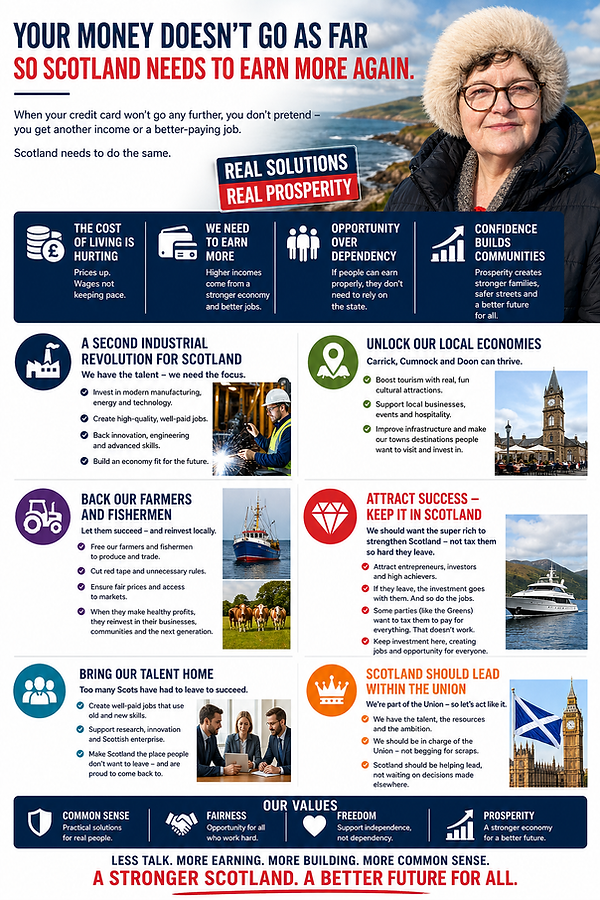
Carrick, Cumnock and Doon Valley - our home
This area helped power the country once -- and it can again.
We need to stop talking ourselves down. We have the skills, the workforce, and the industrial heritage--including coal -- that built strong communities and real opportunity.
There is no reason we can't harness that strength again to support jobs, industry and affordable energy.
But our future isn't just industry. We are the home of Robert Burns -- known across the world -- and we should be making far more of that.
We need leadership who recognise the value of business. It is not shameful to make money, employ people and contribute to society that way.
I would shamelessly promote our beautiful area. We need well paying jobs in new and old industrys. And our farmers and fishermen should be freed to produce high quality ethically produced food for us all and a good livelihood for themselves.
We have got the history. The landscape. The people.
Now we need the ambition and strong leadership to match.

Get involved
If you want practical solutions, honest leadership, and someone who will actually take responsibility — I’d be grateful for your support.
Get in touch
Your participation can make a significant impact. Get involved today to contribute towards a better tomorrow.

